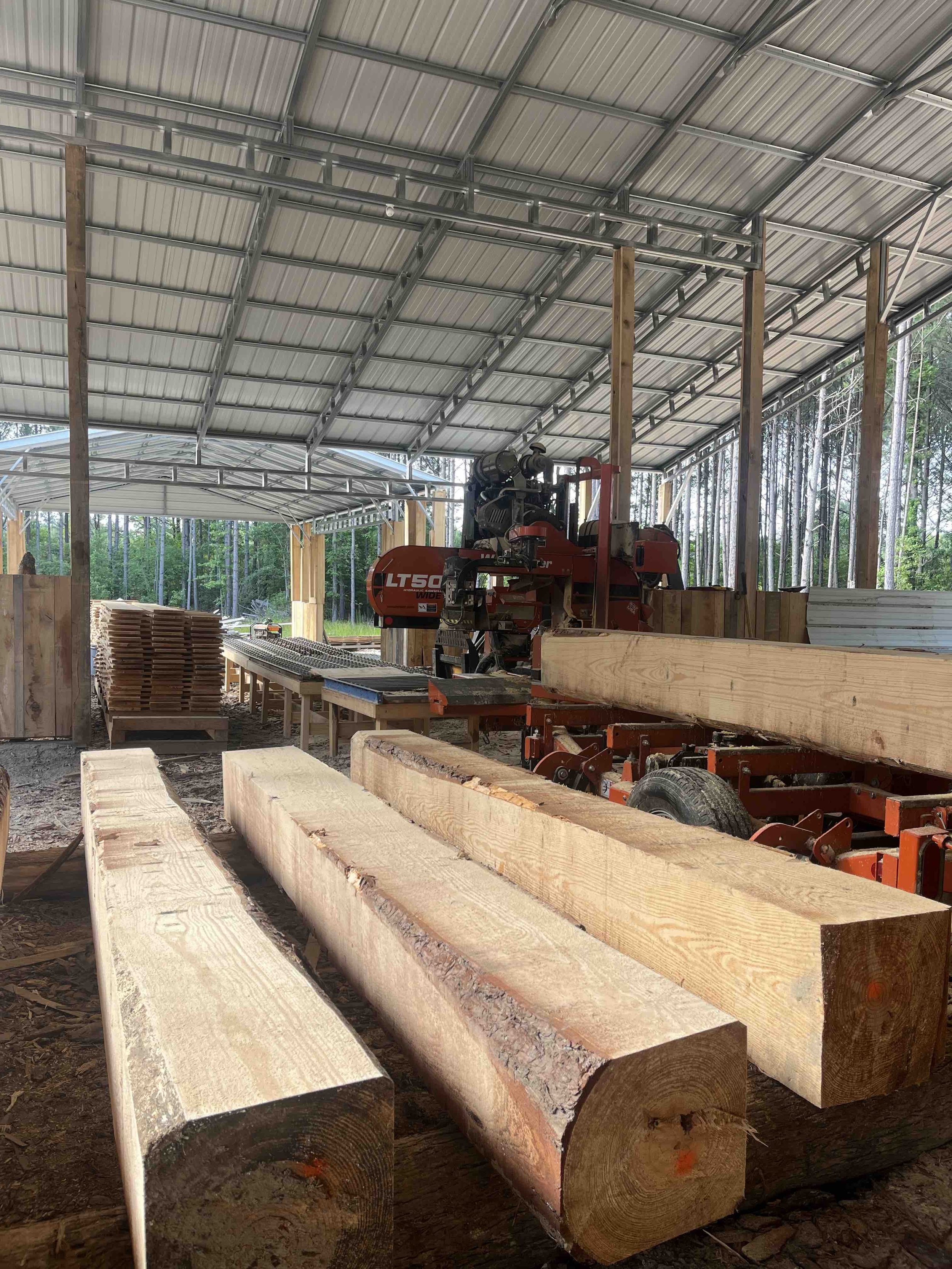
Custom Milling
Over the last fifteen years, we have milled millions of board feet of lumber for homeowners in NC. Send us your logs and we’ll cut them into any dimensions you’d like.
We operate three sawmills at our facility in Saxapahaw. Our largest sawmill can handle logs up to six feet wide, and our main sawmill cuts logs up to 26’ long. We can also kiln-dry, plane, and edge your lumber. We specialize in turning your logs into tongue and groove, or shiplap, paneling, siding, and/or flooring.
Below, you'll find how the process works, what it costs, and what to expect from log delivery through lumber pickup. For more information, visit our FAQ pages.
How Custom Milling Works
Tell us about your logs. Let us know your logs’ species, sizes, and quantity. We'll give you a ballpark cost for milling them into lumber. Text us the details at 336-376-7327.
Get your logs to our sawmill. Bring them yourself, ask your arborist to deliver them, or arrange transportation with one of our log-hauling contractors. Text, call, or email to coordinate a time. Most weekdays 8-5 work.
We mill your lumber. After you tell us the dimensions you'd like, we'll mill your logs. We can cut boards, beams, posts, slabs, etc.
Pick up your lumber or let us take it further. Once the milling is complete, you can pick up your lumber, arrange delivery, or have us sticker and stack it for drying. We can also kiln-dry and/or put custom profiles on your lumber.
You don't need to have every detail figured out when your logs arrive. Many customers are still deciding what to make, and we're happy to help.
Prices and Key Dates at a Glance
We charge by the hour and our rates are as follows:
Standard milling — logs up to 36" diameter and under 4400 lbs
$155 per hour
$25 per blade used
$35 per blade damaged
Oversized milling — logs over 36" diameter and over 4400 lbs
$250 per hour
$100 per blade used
$150 per blade damaged
Project minimum
Custom milling projects have a four-hour minimum. That translates into $620 plus blades for standard milling. (For reference, within a larger milling project, a typical 16–24" diameter log, 8–12' long, takes about 45–60 minutes to mill, or $115–155 in milling time, plus blades). You can use this custom calculator to estimate project costs.
Key Dates
Before milling (counted from the day your logs arrive)
Day 0 – Your logs arrive. We check their condition and estimate board footage.
Days 1–14 – Free storage while we talk through your project and you put together a cutlist.
Day 15 – If we don’t have your cutlist yet, log storage fees begin.
Day 60 – Cutlist deadline. If we still don’t have one, we mill your logs to a standard cut.
Milling, pickup, and payment
About 2 weeks after you send a cutlist – We mill your logs, send your invoice, and arrange pickup, storage, or delivery.
Days 1–7 after milling – Free pickup window.
Day 8 after milling – Lumber storage fees begin.
30 days after invoice – Payment due.
What We Can Mill
Our three sawmills give us the flexibility to handle everything from smaller logs to oversized hardwoods. Most projects run on our Wood-Mizer LT50, which handles logs up to 36" in diameter and 26' long. It's an efficient machine for cutting boards, beams, posts, and other dimensional lumber. Larger logs go on our Lucas slab mill, which can cut logs up to 72" wide and 12' long. It's particularly useful for extra-wide slabs and for squaring oversized logs into cants that we can finish on our faster mills. We can also work with you on specialized cutting patterns, including quartersawing and other cuts intended to bring out the best in your wood.
Not every log is safe or practical to mill. Please tell us if your logs may contain embedded metal, rocks, significant decay, or other unusual conditions. We charge $1/board foot for disposing of logs unsuitable for milling.
How Long Does It Take to Mill a Log?
It varies enormously. A 10" cedar log might take just 10 minutes to turn into a 6x6 post. We've also spent an entire day quartersawing a single 60" log. As a general rule, the cleaner, greener, softer, and rounder the log, the faster it goes. The fewer cuts you need, the faster it goes. Logs over 36" typically take at least an hour. Hardwoods that have been down for more than a year can be harder on blades and may require extra time. That's why we bill by the hour: you're paying for the work your particular logs require.
Getting Your Logs to the Sawmill
You have three options:
Bring them yourself. A truck and trailer are all you need, provided they're suitable for the size and weight of your logs.
Have your arborist deliver them. If a tree is already coming down, having the arborist bring the logs directly to us is often the most economical and convenient option.
Hire a log hauler. We can connect you with contractors who transport logs to our sawmill.
Please contact us before arranging delivery so we can confirm that your logs are suitable for milling and that we're ready to receive them. And please read our cutlist and storage terms below before dropping off logs.
Your Cutlist and Log Storage
Lots of folks bring us logs before they know exactly what lumber they want. That's totally normal. A cutlist is simply a description of what you'd like us to mill: the thicknesses, widths, lengths, and quantities you're after. It can be as straightforward as a stack of 1x8 boards or as detailed as a list of beams and framing lumber for a house. We're happy to give you some time to decide. But logs don't improve with age, and storing them indefinitely creates problems for everyone. Here's how our process works.
The First Two Weeks Are Free
We'll scale your logs when they arrive to estimate their board footage. This establishes your storage rate if you need additional time. You can store your logs free for the first 14 days.
After Two Weeks: Log Storage Fees
Beginning on day 15, storage costs $12.50 per week for every 1,000 board feet of logs, based on our log scale and rounded up to the next 1,000 board feet. For example, 1,500 board feet of logs would be billed as 2,000 board feet, or $25 per week. The storage fee stops as soon as we receive your cutlist. And if we're the holdup, you don't pay storage. Once you've given us your milling instructions, any additional wait for our milling schedule is on us.
The 60-Day Cutlist Deadline
Please provide your cutlist within 60 days of delivering your logs. We'll send you a reminder before the deadline. If we still haven't received a cutlist after 60 days, we'll mill your logs to a practical standard cut for that species. We'll sticker and stack the finished lumber, invoice you for milling and stacking and storage charges, and make the lumber available for pickup.
Why These Deadlines Matter
Logs lose value while they wait. Pine, in particular, can develop blue stain within weeks during warm weather. Other species may develop checking, insect damage, or decay if they sit too long. We recommend milling logs as promptly as practical, especially during the summer.
After Your Lumber Is Milled
We'll keep you posted as your logs move through our milling queue and let you know when your lumber is ready for pickup, delivery, or storage.
Loading and Pickup
For small homeowner orders (three to ten logs), loading is included in the milling price. For larger orders or loads requiring 30 minutes or more of loading time, an additional hourly loading charge applies. You have seven days of free lumber storage after milling to arrange pickup. Beginning on day eight, storage costs $12.50 per pallet per week. We do our best to remind you about your lumber stored at the sawmill after your free week. If you miss your first pickup deadline, it is not our responsibility to remind you to pick up your lumber while storage charges accrue.
Protecting Freshly Milled Lumber
Green lumber piled tightly together traps moisture, which leads to stain, mold, and uneven drying. Left in the sun or rain, it can also warp or check. The fix is stickering: placing thin strips of wood between layers so air can circulate around every board. If your lumber won't be picked up and stacked right away, we recommend stickering it promptly — sometimes right after milling, depending on the species and the weather. We'll talk it through with you before milling. Any lumber still here after the seven-day pickup window gets stickered and stacked if it hasn't been already.
Stickering, Stacking, and Lumber Storage
You have several options for stickering your lumber.
Supply your own stickers. You can bring dry, untreated wooden strips suitable for stacking lumber. Kiln-dried furring strips from a hardware store can work well.
Let us cut stickers from your logs. If you're bringing softwoods, we can often use some of your wood to make stickers.
Purchase our stickers. We make 1x1x3' stickers specifically for lumber stacking. They're ready to use and cost $0.75 each.
Our stickers are better; store-bought ones are cheaper. For guidance on how to stack your lumber properly, see our guide to stacking lumber.
Let Us Handle It
We can take care of the entire process: stickering, stacking, and storing your lumber while it dries. Our charges are:
Stickers – $0.75 each
Stacking labor – $155 per hour for a two-person crew (total crew rate)
Storage – $12.50 per pallet per week after the first seven days
This is a good option for customers who don't have the time or space to stack lumber themselves, and for homeowners or builders who want to dry lumber before using it in a project. We also offer kiln drying and custom millwork for customers who want to turn rough-sawn lumber into finished building materials.
Lumber Delivery
We can deliver your lumber after milling. Within 25 miles of our sawmill:
Loads under 2,000 lbs – $300
Loads over 2,000 lbs – $600
Larger loads, extra-long lumber, or deliveries beyond 25 miles are quoted individually. We usually charge $5-8 per roundtrip mile beyond the first 25 miles. Let us know your delivery location and what you're having milled, and we'll help you work out the logistics.
Payment and Unclaimed Lumber
All invoices are due within 30 days. Milling, lumber storage, kiln drying, and millwork may be billed separately, and each invoice has its own 30-day deadline. We release lumber once its milling invoice is paid. If you decide you no longer want your stored lumber, after you have paid milling costs, just let us know. We may keep it in exchange for settling your storage invoice.
A Common Question: Can We Trade Our Logs for Milling?
We get this question a lot, particularly from people having trees removed from their property. Unfortunately, we don't accept logs or a share of the finished lumber as payment for milling. Our milling services are billed at the rates described above. If you need help getting your logs to us, we're happy to discuss transportation options.
Ready to Get Started?
Tell us a little about your logs and what you'd like to make. The most helpful information is the species, approximate number of logs, diameters, lengths, and whether you have a particular project in mind. Photos are always welcome. We can help you think through the best cuts, estimate milling time, and plan the next steps.
Request a Custom Milling Estimate
Still have questions? Visit our Custom Milling FAQ for more information about logs, lumber, drying, and what to expect when working with a sawmill.